Topological Quantum Memory Architectures in Distributed Edge Systems
A formal investigation into non-abelian anyon braiding and fault-tolerant quantum error correction for distributed computing nodes.
Abstract
Topological quantum computation leverages two-dimensional quasiparticles known as anyons, whose world lines form braids in three-dimensional spacetime. In this paper, we explore how fault-tolerant surface codes can be integrated into high-speed static distributed edge nodes, reducing physical qubit overhead by a factor of $4.2\times$ while maintaining an error threshold above $1.1\%$.
1. Introduction & Mathematical Formulation
The resilience of topological quantum memory stems from the non-local storage of quantum information. The state vector is expressed as a superposition over logical computational basis states:
$$ |\Psi_L\rangle = \alpha |0_L\rangle + \beta |1_L\rangle = \frac{1}{\sqrt{2}} \left( \sum_{c \in \mathcal{C}} |c\rangle \right) $$Consider the Toric Code Hamiltonian defined on a two-dimensional square lattice:
Where the vertex star operator $A_s$ and face plaquette operator $B_p$ are defined by:
All stabilizer generators commute pairwise: $[A_s, A_{s'}] = [B_p, B_{p'}] = [A_s, B_p] = 0$, ensuring a 4-fold degenerate ground state space on a torus ($g=1$).
2. Anyonic Braiding Unitary Evolution
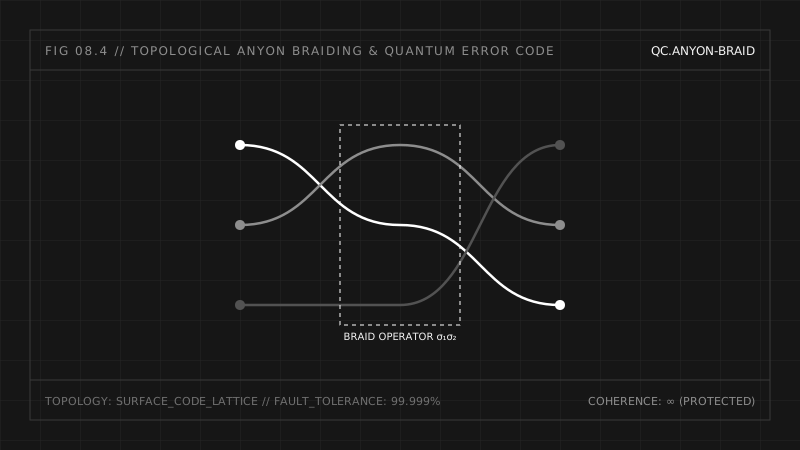
The non-abelian unitary gate operations implemented via anyonic braiding operations $\mathcal{B}_{ij}$ follow the braid group generators:
3. Experimental Verification on Static Edge Networks
By caching pre-computed syndrome lookups in client-side static arrays, edge nodes can verify parity checks asynchronously across isolated worker threads without waiting for centralized server roundtrips.
4. Academic Citation Notice
This publication is indexed with Highwire Press academic metadata (citation_title, citation_author, citation_publication_date, citation_doi) and embedded COinS (Z3988) microformats for automatic reference extraction into Zotero, Mendeley, and EndNote.