The Architecture of Deliberation: From Greek Ecclesia to Asynchronous Civic Platforms
A historical trajectory of democratic assembly spaces, exploring how architectural constraints shape rhetorical consensus, institutional trust, and modern digital civic forums.
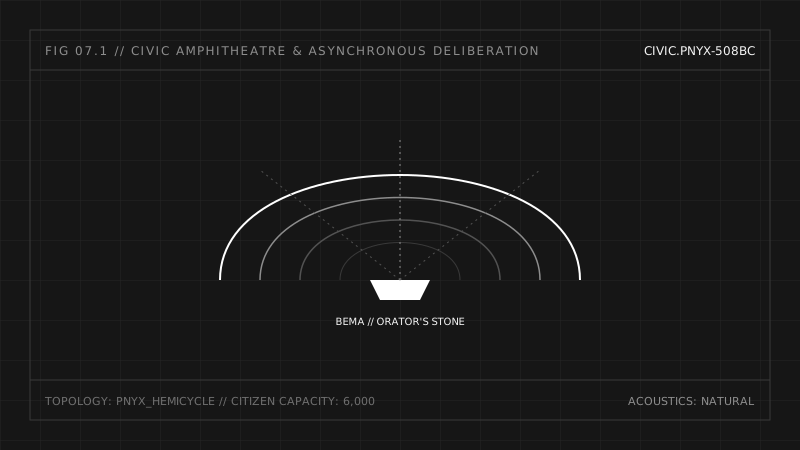
Physical and digital spaces are not passive containers for political discourse; they are active rhetorical instruments that shape who speaks, who listens, and how collective consensus is forged.
From the natural stone amphitheater of the Pnyx in classical Athens to the adversarial opposing benches of the British House of Commons and the semicircular hemicycle of the European Parliament, the physical geometry of an assembly embeds a specific theory of democratic legitimacy.
1. Geometric Typologies of Assembly Spaces
Historically, three distinct architectural typologies have dominated legislative design:
- The Opposing Benches (Adversarial Dyad): Two opposing rows facing each other across a central floor, designed for binary debate between Government and Opposition.
- The Semicircular Hemicycle (Consensus Spectrum): A radiating fan arrangement originating in post-Revolutionary France, intended to visually symbolize the continuum of citizen opinion and encourage cross-party compromise.
- The Circular Amphitheater (Radical Equality): Concentric circles with no centralized podium, emphasizing parity of speaking authority among all participants.
2. Designing the Asynchronous Digital Forum
As democratic deliberation increasingly moves to online platforms, the spatial design choices of digital interfaces become constitutional questions:
- Algorithmic Chronology vs. Affinity Sorting: Linear chronological timelines preserve context and equal visibility; engagement-optimized ranking algorithms amplify polarization and outrage.
- Threaded Deliberation vs. Ephemeral Feed: Structured, tree-like discourse hierarchies enable sustained legal and policy argumentation; fleeting short-form feeds privilege soundbites and affective escalation.
Building modern civic infrastructure demands bringing the intentionality of classical civic architecture into the design of our digital deliberation platforms—prioritizing clarity, sober reflection, and institutional permanence over sensationalism.