Zero-Knowledge Statecraft: On-Device Machine Learning and Civic Privacy
How WebGPU and quantized local neural architectures enable intelligent civic services without centralizing citizen biometric or query data.
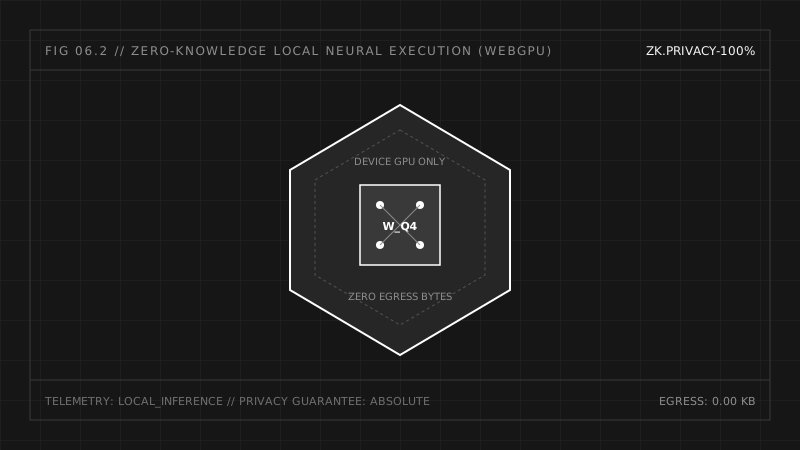
The Zero-Data Retention Principle
By executing inference directly within client hardware memory via WebGPU shaders, no prompt tokens or queries ever leave the user's sandbox.
The rapid proliferation of centralized cloud-hosted large language models has raised urgent civil liberties and data protection concerns. When public administrations integrate AI assistants that transmit citizen inquiries, legal filings, or health metadata to third-party commercial servers, they introduce severe vector risks for surveillance, data leakage, and regulatory non-compliance.
The emergence of browser-native, client-side neural execution via WebGPU, WebAssembly (WASM), and INT4/INT8 quantization provides an elegant, privacy-preserving paradigm.
1. Interactive On-Device AI Specimen
Experience browser-native machine learning in real-time below. Model weights run directly on your GPU/WASM pipeline:
On-Device Civic Research Assistant
On-Device WebLLM • Static Vector RAG
2. Technical Mechanics of On-Device Inference
| |
3. Democratic Implications for Civic Technology
Client-side AI reconciles the power of advanced cognitive assistance with the constitutional imperative of citizen privacy. When digital civic tools process voter guidance, tax calculations, or municipal petitions entirely on-device, citizens engage freely without the chilling effect of permanent surveillance logging.