The Geopolitics of Silicon: Critical Mineral Dependencies and Industrial Autonomy
A strategic assessment of extreme ultraviolet lithography monopolies, rare-earth choke-points, and European technological sovereignty in multilateral supply chains.
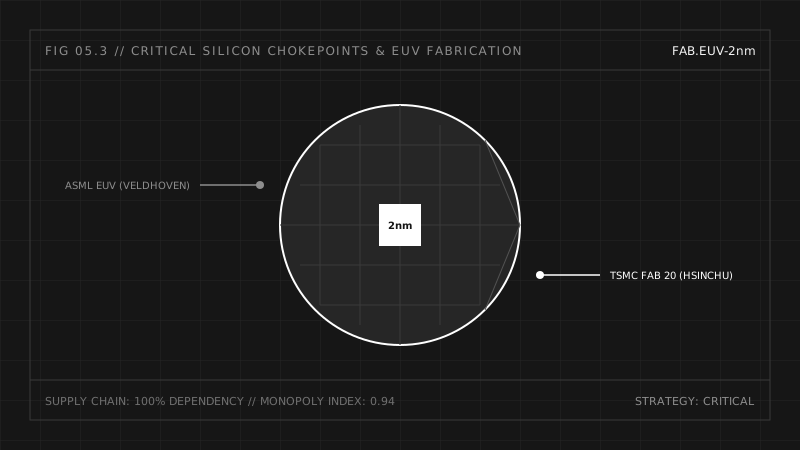
The global semiconductor supply chain is arguably the most mathematically complex, capital-intensive, and geographically concentrated industrial apparatus in human history. A single leading-edge 2nm or 3nm integrated circuit traverses more than 40,000 miles across dozens of international borders before reaching final deployment.
This extreme specialization has created profound geopolitical vulnerabilities. From Dutch extreme ultraviolet (EUV) photolithography optics to Taiwanese fabrication foundries and Japanese photoresist chemistry, the global technological stack rests upon fragile, non-redundant choke-points.
1. The Anatomy of Strategic Choke-Points
Leading-edge semiconductor manufacturing relies on three distinct structural moats:
- Extreme Ultraviolet (EUV) Tooling: Monopoly dominance in 13.5nm wavelength optical mirrors and laser-produced plasma systems capable of firing 50,000 molten tin droplets per second.
- Advanced Packaging & EDA Software: Proprietary electronic design automation algorithms that map tens of billions of transistors with zero physical defect tolerance.
- Critical Material Refining: Upstream concentration of gallium, germanium, polysilicon, and specialized rare-earth permanent magnets.
| |
2. Strategic Imperatives for European Industrial Policy
For the European Union and allied democratic polities, the objective of initiatives like the European Chips Act cannot be complete autarky—a goal rendered economically prohibitive by trillions in required capital expenditure.
Instead, industrial strategy must target asymmetric indispensability: securing dominant technological footholds in specialized machinery, quantum photonics, and analog automotive silicon while diversifying critical material supply chains through strategic bilateral partnerships across South America, Africa, and North America.