The Multidisciplinary Imperative: Bridging Political Theory and Systems Engineering
Why 21st-century governance demands fusing classical political philosophy with computational systems logic, deterministic state machines, and human-centered design.
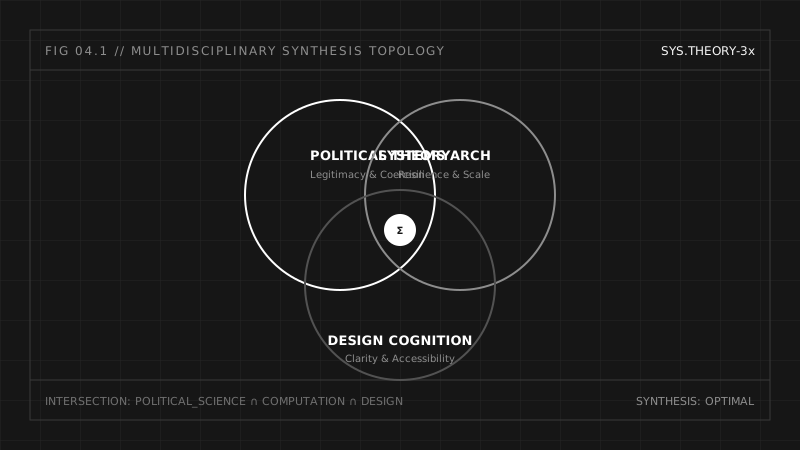
Contemporary policy debates frequently suffer from a profound intellectual bifurcation. On one side stand political scientists and legal scholars steeped in institutional history, constitutional jurisprudence, and normative philosophy—yet often disconnected from the computational mechanics that govern the modern digital substrate. On the other side stand computer engineers and technologists proficient in protocol architecture and distributed systems—yet frequently naive regarding institutional power dynamics and democratic accountability.
This epistemic divide is no longer sustainable. Addressing the systemic crises of our era—from algorithmic bias in public benefit allocation to international information warfare—requires a truly multidisciplinary synthesis.
1. Classical Political Thought as System Architecture
When Aristotle categorized constitutional regimes in Politics, or when James Madison engineered the checks and balances of Federalist No. 51, they were engaged in rigorous system architecture. They were defining:
- State Spaces: The distribution of citizen privileges and executive prerogatives.
- Incentive Alignment: Designing counterbalancing mechanisms to prevent single-point-of-failure autocratic capture.
- Feedback Loops: Periodic electoral interrupts designed to stabilize volatile social dynamics.
2. Computational Logic in Policy Assessment
Conversely, principles from computer science—such as encapsulation, deterministic state transitions, idempotency, and graceful degradation—offer powerful mental models for public policy design. When drafting legislation, treating statutory provisions as edge cases in an operational state machine prevents contradictory mandates and unintended consequences.
The future of strategic advisory lies with practitioners who can fluidly translate between Machiavellian political realism, Rawlsian distributive justice, and low-level computational architecture.