The Geometry of Parliaments: Electoral Systems and the Mathematics of Representation
A comparative structural analysis of proportional representation models, D'Hondt quotient distributions, and the geometric dynamics of legislative coalition building.
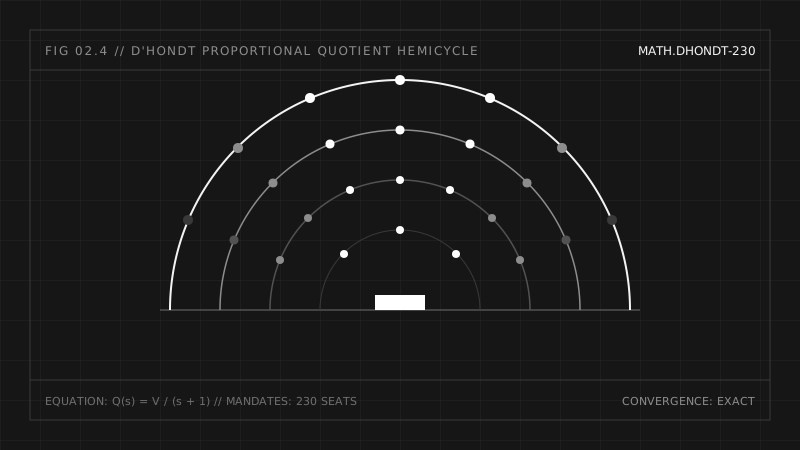
The design of an electoral system is never merely a technical mechanism for aggregating ballots; it is the fundamental constitutional geometry that determines how political conflict is organized, channeled, and reconciled within a democratic society.
Different allocation algorithms create distinct structural incentives. While majoritarian systems (First-Past-The-Post) artificially manufacture single-party legislative majorities at the expense of proportional fidelity, proportional representation systems translate citizen preferences into fractional parliament seats with mathematical precision.
1. The D’Hondt Quotient Mechanism
Among highest-averages methods, the D’Hondt method (formulated by Belgian jurist Victor D’Hondt in 1878) allocates seats sequentially through iterative quotient calculations:
$$Q_i = \frac{V_i}{s_i + 1}$$Where:
- $V_i$ represents the total valid votes cast for party $i$.
- $s_i$ represents the cumulative number of seats allocated to party $i$ prior to the current round.
2. Thresholds and Spatial Stability
In multi-member constituencies (such as the Portuguese Círculos Eleitorais or European Parliament districts), the effective electoral threshold $T$ is functionally defined by both statutory minimums and the constituency magnitude $M$:
$$T_{eff} \approx \frac{75\%}{M + 1}$$In small constituencies where $M = 3$ or $M = 4$, the effective threshold can exceed 15% to 18%, creating an implicit majoritarian bias despite a formal proportional framework. Understanding these mathematical parameters is essential for constitutional advisors and policy architects seeking balanced representative assembly design.